
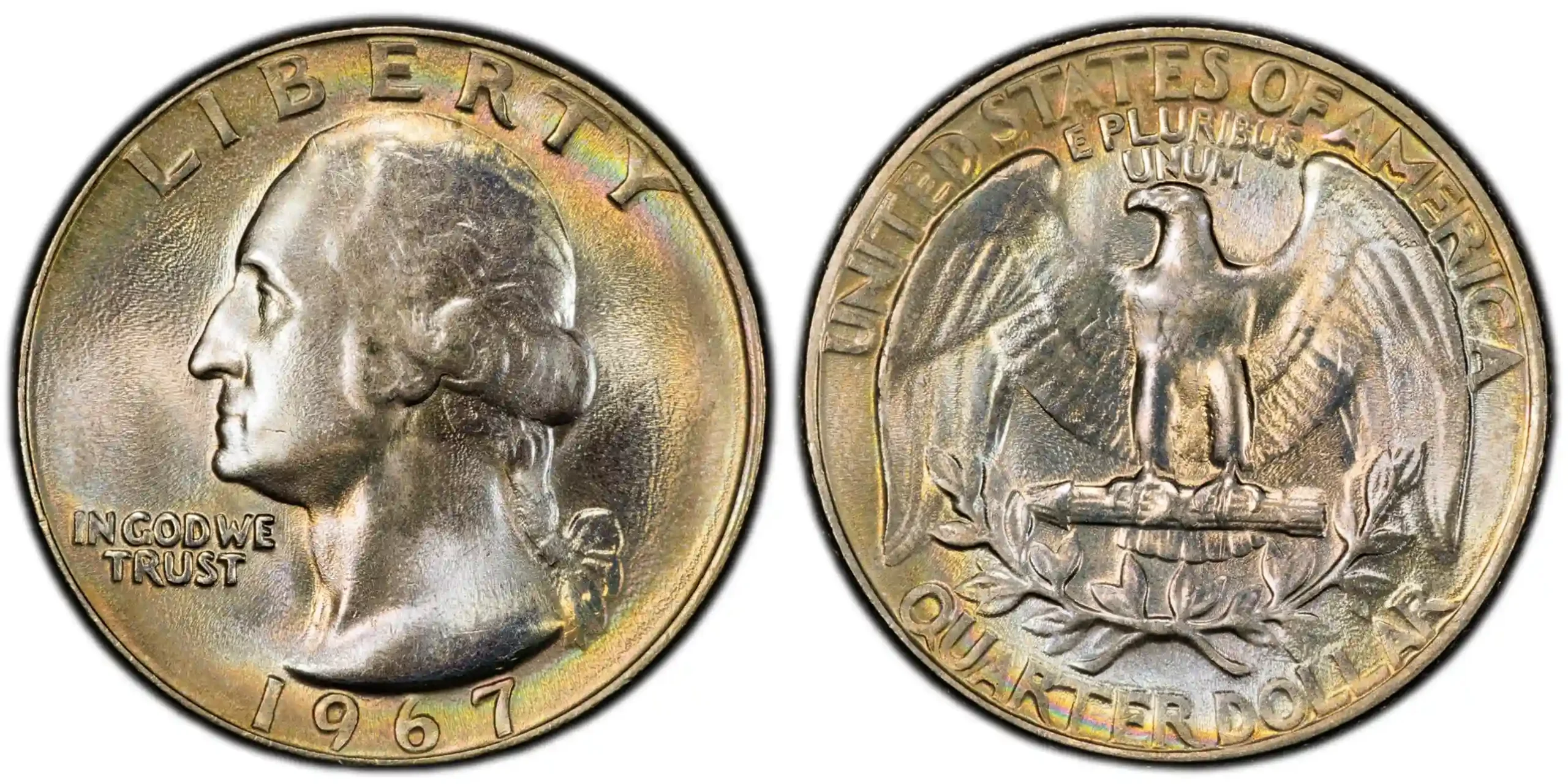
The 1967 quarter no mint mark price starts at $0.25 and up to $100 or more dollars for SMS issues.
Where Did the Mint Marks Go?
Look at a standard United States quarter today. You will find a small letter near the portrait of George Washington or next to the eagle on the reverse side. This letter represents the mint mark. It identifies the specific facility that manufactured the coin.
- The Philadelphia Mint uses a P
- The Denver Mint uses a D
- San Francisco Mint – an S
The area near the bow of Washington’s hair remains completely blank. Many people notice this detail and immediately suspect a production mistake. To understand this absence, you must look at the specific design choices of the United States Mint during the mid-1960s.
Is Your 1967 Quarter a Rare Error or a Common Circulation Coin?
The United States Mint deliberately eliminated these letters from all coins between 1965 and 1967. Therefore, your coin does not possess a rare error. It represents a standard piece of currency from a unique era in American fiscal history. The government minted over 1.5 billion of these coins, so they remain a frequent sight in daily commerce.
Item Value & Specifications
Circulated item value is $0.25+. The standard SMS issue price is $15–$24.
| Year | 1967 |
| Diameter | 24.26 mm |
| Weight | 5.67 g |
| Composition | Copper-nickel clad |
| Edge | Reeded |
The Coinage Act of 1965: The Real Reason Behind the Missing Marks
The Great Coin Shortage of the Mid-1960s
During the early 1960s, the United States faced an acute shortage of small change. Business owners struggled to give customers correct change during regular transactions. Banks ran low on:
- Dimes
- Quarters
- Half dollars
Several factors drove this crisis. Economic growth increased the demand for physical cash. At the same time, the rising price of silver caused panic among the public.
Citizens realized that the metal inside the coins would soon surpass the face value of the currency. People began to store massive quantities of coins in their homes, which removed liquidity from the financial system.
Blaming the Numismatists: Why Mint Director Eva Adams Removed Mint Marks
| Factor | Details |
| Target | Coin collectors and numismatists |
| Blame | Hoarding specific mint issues for profit causes a coin shortage |
| Strategy | Remove all individual mint marks from U.S. coins |
| Legislation | Coinage Act of 1965 |
| Goal | Kill the collector interest to force coins back into public circulation |
The Director of the United States Mint, Eva Adams, looked for a scapegoat to explain the coin crisis. She fixed her attention on numismatists and coin collectors. Adams believed that collectors drove the shortage because they withdrew specific mint issues from circulation to profit from their rarity.
To combat this perceived threat, Adams proposed a psychological strategy. She decided to strip all coins of their individual mint identity.
Congress codified this decision within the Coinage Act of 1965. Adams believed that if a coin lacked a specific location mark, collectors would lose interest in it. The government hoped this move would force coins back into public circulation.
Where Were 1967 Quarters Actually Minted?
Although the coins looked identical, three different facilities produced the 1967 quarter. The Philadelphia Mint, the Denver Mint, and the San Francisco Assay Office all operated their coin presses at maximum capacity to satisfy national demand.
Because the government banned mint marks, you cannot definitively prove which facility struck a specific regular circulation 1967 quarter. The Philadelphia Mint traditionally struck coins without marks, but during this period, Denver and San Francisco did the exact same thing. The three locations combined their efforts to flood the market and resolve the national coin drought.
Transitioning from Silver to Clad: The 1965–1967 Composition Shift
Moving Away from 90% Silver
- Before 1965, the United States Mint used an alloy of 90 % silver and 10 % copper.
- As the global price of silver escalated, the intrinsic value of the metal threatened the stability of the currency.
- If silver prices rose too high, people would melt down their quarters for raw bullion profit.
This reality forced the United States government to abandon the silver standard for circulating fractional coins. The Coinage Act of 1965 legally authorized the transition to a cheaper base metal composition.
How the New Copper-Nickel Clad Composition Affected Production
The Mint replaced silver with a clad composition. If you check coin-identifier.com, you know that this design utilizes an inner core of pure copper between two outer layers of an alloy containing 75 % copper and 25 % nickel.
This change altered the production process at the mints. The copper-nickel material possessed greater hardness than the old silver alloy.
Coin dies experienced higher stress during production, which caused them to wear out faster. Workers had to adjust the pressure on the coin presses to ensure clear strikes on the new, harder blanks.
What Is a 1967 SMS Quarter?
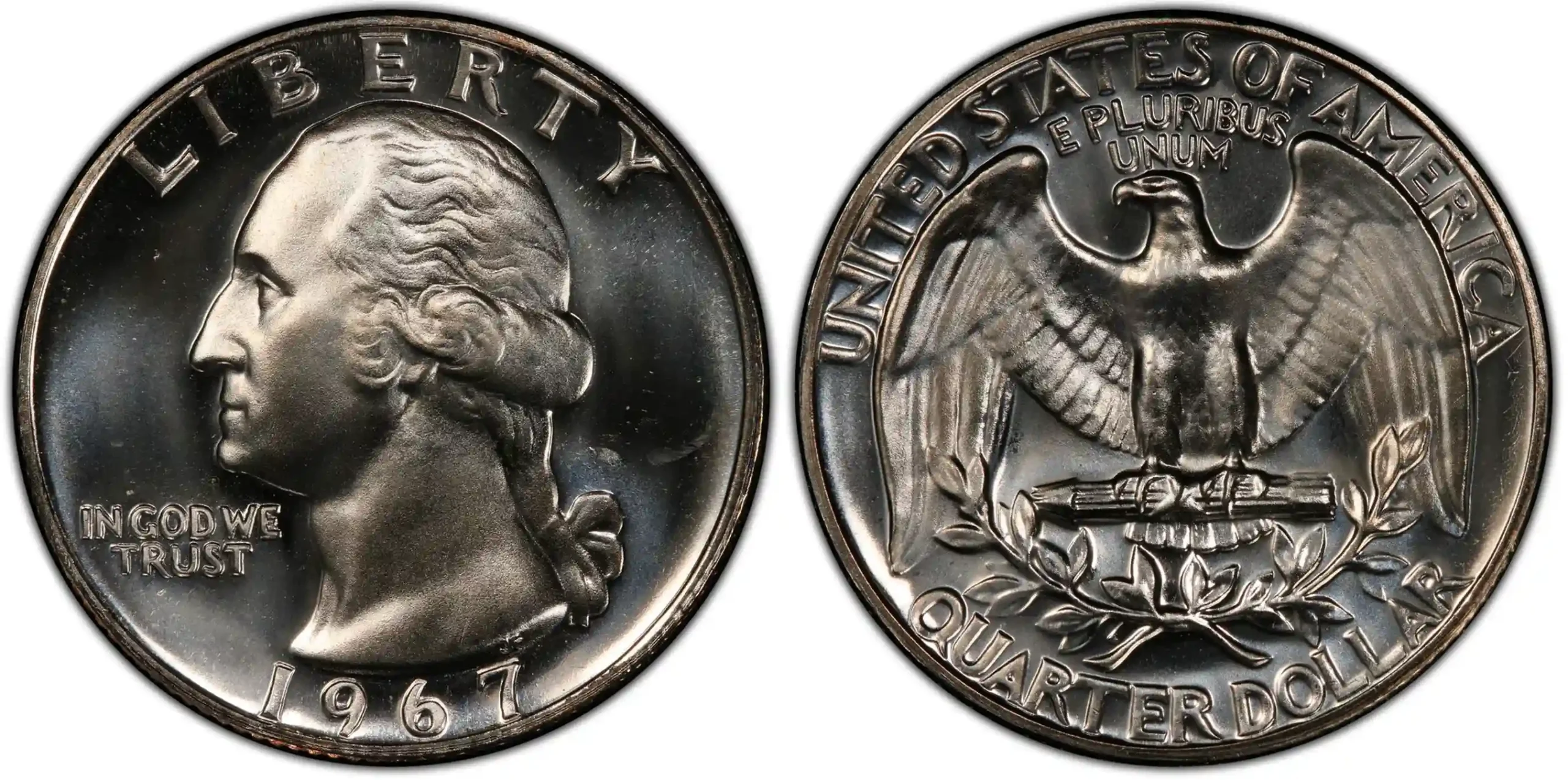
The Mint canceled regular proof sets and uncirculated coin sets in 1965 to focus all energy on circulation coins. The government still wanted to provide a product for collectors. The Mint created Special Mint Sets, which people call SMS sets.
The 1967 SMS quarter originated from prepared blanks. Workers struck these coins once on high-pressure presses. They did not possess the mirror finish of a traditional proof coin, but they displayed much sharper details than standard pocket change.
How to Identify a Special Mint Set Quarter and a Business Strike
Step 1 – Examine the Surface Reflectivity
Business Strike – the background will have a standard satin or frosty texture. When you tilt the coin under a single light source, the light will diffuse into a cartwheel luster pattern rather than reflecting sharply.
SMS Quarter – the fields on a 1967 SMS quarter have a semi-prooflike, glassy, or mirrored quality. While not perfectly mirror-smooth like a traditional proof coin, the surface will clearly reflect light and shapes, exhibiting “watery” fields.
Step 2 – Analyze the Sharpness of the Strike
Business Strike – the details on the raised parts of the design (the relief) are often softer. Check Washington’s hair braids above his ear and the feathers on the eagle’s breast. In circulation strikes, these details are frequently flat or slightly blurry right from the factory.
SMS Quarter – the strike is incredibly crisp and fully realized. You will see distinct, sharp lines in Washington’s hair and individual, fine feather lines on the eagle. The rims (the outer raised edges of the coin) will also look square and sharp, rather than slightly rounded.
Step 3 – Check for Surface Blemishes
Business Strike: Circulation quarters were dropped into large bins with millions of other coins right after striking. Even in uncirculated condition, they almost always show minor nicks, scratches, and dings known as “bag marks.”
SMS Quarter – these pieces were handled with care and placed directly into plastic sets. They will be virtually free of contact marks or scratches. Instead, if you look closely under a magnifying glass, you might see tiny, faint die polishing lines or flow lines running through the fields, but no heavy nicks from other coins.